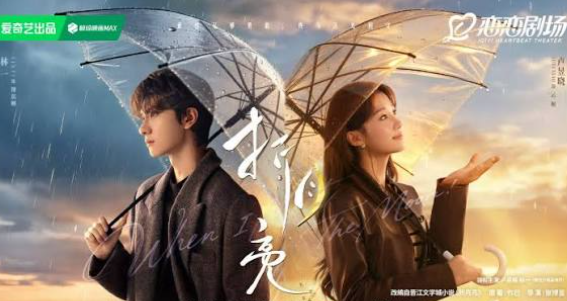
When I Meet the Moon tells the story of mutual secret crushes that were derailed by a tragedy in our hero’s life when his best friend committed suicide. A couple of years later, our heroine runs into our hero again while interning at his company. Undaunted by the fact that the once sunny and dazzling boy she had secretly loved is now a shell of his former self, our heroine gathers her courage to pursue him in earnest.
Overall review and Novel Comparison:
I would probably give this one a 7/10. The drama tried hard to stick to the novel it was adapted from but made a few strategic mistakes that, in my opinion, harmed the overall feel of the story. Out of the trilogy, When I Meet the Moon is probably the heaviest out of the three. From the get-go of the novel, the hero we meet is not the sunny, dazzling boy our heroine fell in love with but one at his breaking point, a man wrecked day and night by guilt and regret over his best friend’s death. The author never comes right out and says it, but as a reader, one gets a distinct feeling that our hero is not so slowly erasing himself. In most stories, an ever-happy and optimistic heroine would pop out and rescue our hero…but in When I Meet the Moon, we get a heroine who, while determined to rescue our hero, carries a fair share of her own pain. This story packs a lot of trauma, and it lays it out in front of the reader pretty much right from the beginning. With that being the case, the novel really did feel pretty dark at times (balanced out by the hero’s unexpected dry humor and our heroine’s tendency to blurt out the most surprising words), but then it made the growth and redemption that much sweeter.
In my opinion, one of the biggest strategic mistakes the production made was to downplay the heaviness of the story. But perhaps that’s not a fair statement to make since we did find out about the friend’s suicide fairly early in the story. I guess the novel has the advantage of showing the reader the dark abyss that is constantly swirling around our hero’s mind, so as a reader, we are fully aware of the tortured pain he is under the whole time. I guess to me, Fu Shize in the drama is someone trapped by the trauma of the past, and one can still see that, with time and support from others, he can eventually move past that trauma. In contrast, Fu Shize in the novel makes me nervous and anxious, as if I am watching someone standing right at the edge of the cliff.
It does make me wonder if our hero could have fallen in love with anyone other than our heroine, considering the state he was in. Our heroine was someone he already had feelings for back in his glory days. She was a beacon of light he remembered from back when he was also equally bright and dazzling. That means our heroine was automatically different, since she was already in his heart before he sealed himself off. His icy shell couldn’t be cracked from the outside but could from the inside.
A few other notable differences between the drama and novel:
1. A big part of our hero’s friend’s depression came from being unfairly taken advantage of by his advising professor. Hopeless when his professor blatantly tells him that he is too useful as free labor to be allowed to graduate with his Ph.d, our hero’s friend becomes even more despondent after his professor forces him to hand over his research to another student. After the friend’s death, our hero personally made sure that the professor was punished professionally and in criminal justice for what he did.
2. The author never put any labels on it, but I personally would call our heroine’s dad emotionally abusive when it comes to his kids. Now, there was no doubt that her dad truly loved his kids and was doing the best he knew how. However, his actions, no matter his intention behind them, were emotionally abusive and created lasting trauma in both of his kids. The drama showed some of it, but it was much more spelled out in the novel that our heroine’s timid personality and discomfort in crowds were largely trained by her father. Scared that her loss of hearing in one ear would make the world a much harsher place for his daughter, our heroine’s dad constantly reminds her of her disability and how the others might perceive her. Suffering through her dad’s good intentions during her growing-up years, our heroine often had no one to turn to other than her younger brother, who, despite being young, tried the best he knew how to comfort her but still felt the helplessness of his inability to change the situation they both were in. An interesting side note that I am not sure came off as clearly in the drama as it did in the novel is that our heroine is very wary of any man who shows any interest in her. She almost has an inability to see any interest in her as a positive thing but instinctively wants to either go on the defensive or hide…of course, none of this applies to our hero.
3. I am both puzzled and sad that the drama decided to take away the comedic moments between the first and second male lead. The secondary male lead I am referring to is Yu Cheng, the brother of our heroine’s younger brother’s love interest. Using the budding romance between their younger siblings, Yu Cheng tried multiple times throughout the story to show his interest in our heroine. Unfortunately for the guy, our hero keeps showing up at the most inopportune time…so much so, that by the final time (when the heroine’s father invited him to the house), it was comical for all three of them. Instead of being sad and hurt as they showed in the drama the last time he got rejected, Yu Cheng was more resigned and had the ‘yep, I knew that guy was gonna show up again’ attitude that just made the whole thing that much funnier.
4. The secondary love line between our heroine’s best friend and our hero’s nephew was not memorable in the novel, but boy, it was super annoying to have such a plain vanilla love line keep showing up everywhere in the drama. They romance played a much smaller role in the novel, so I didn’t mind them there.
5. In the drama, the interactions between our hero and his friend’s parents were somewhat regular, albeit often awkward and mixed in with a few angry outbursts from the dad. In the novel though, the parents wanted nothing to do with our hero, and every interaction between them and our hero was filled with toxic accusations and name-calling from the dad.
6. I was a bit disappointed that in the drama it didn’t come across as clearly, in my opinion, how forced our hero’s return to his outgoing, dazzling former self was for him. Our hero had mistakenly believed our heroine only loved his former sunny self, so after their breakup he did everything he was supposed to and put on the facade of his former self. While glad to see him back in school and looking like his former self, it didn’t take long for our heroine to find out that the pain and guilt our hero had been carrying didn’t lessen at all.
7. The other thing I was surprised the drama didn’t make clear was the fact that our heroine figured out on her own while spending a year overseas that our hero truly did care for her. After blurting out that she wanted to break up and immediately regretting it afterwards, our heroine then went abroad to study for a year on her own, knowing she needed a chance to get over her own insecurities, or else even if she got back with our hero, their relationship would just be doomed again (in the drama, her best friend didn’t go with her). Life abroad was very difficult for our heroine, but as she was able to work on her low self-confidence, she also had time to comb through everything our hero said and did during their time together. In the year they were apart, after countless hours spent reminiscing every moment she spent with Fu Shize, our heroine was finally able to see clearly, without the blinders of her insecurities, that he did love her and that their relationship was never just her begging to be loved.
8. The big reconciliation between our hero and his friend’s parents went mostly how the drama portrayed, sans the VR and the fact that our heroine didn’t take out the files of the diary without telling the parents what they were. In the novel, the parents knew that our heroine had asked for the laptop with the expressed purpose of helping them find their son’s diary. Once our heroine found it, she shared it with the parents and had their permission to have a copy of it. On the parents’ side, their resentment towards Fu Shize was finally replaced with understanding when they read in their son’s own words how diligent Fu Shize had worked to help him take his medicine. For Fu Shize, he was finally able to move past his overwhelming guilt when he realized his friend did not regret their friendship and that not taking his medicine wasn’t an act of suicide but was a mistaken attempt on his part to overcome his difficulties. The diary in the laptop allowed both our hero and the parents to confirm what they didn’t allow themselves to believe previously. Their friend/son was always the same, soft-hearted and kind person they knew. His actions and his words spoken at the height of his illness were not who he truly was. He loved them until the very end and knew throughout his illness how much he was loved by them.
9. One last thing I wished the drama didn’t leave out was the fact that our hero was actually able to help our heroine’s father realize what a talented, capable young woman his daughter had grown up to be. Papa Yun was always a bit grumpy with Fu Shize from the very beginning, but strangely, he actually listens when Fu Shize talks. Towards the end of the story, a now very independent Yun Li was clashing even more with her dad. Feeling hurt and helpless, Papa Yun surprisingly turns to Fu Shize, who patiently teaches him how to follow his daughter’s online channel and explains to him what an impressive number of fans his daughter had. Shocked that what he had always taken as useless nonsense his daughter wasted time on turned out to be so impressive, Papa Yun started to follow Yun Li’s channel and took the first step to start seeing her the way she deserved to be seen.
10. By the way, I saw some viewers criticized actress Lu Yu Xiao for the muffled way she speaks in When I Meet the Moon. Lu Yu Xiao’s voice does have a tendency to sound muffled in all the dramas I have watched with her. However, When I Meet the Moon is probably the only one where her muffled voice is a perfect fit for the character. In the novel, she is often teased by her fans for her propensity to mispronounce words or not speak them clearly. In fact, one of her fans’ favorite things to do is get Yun Li to read a bunch of tongue twisters on her channel. Freely admitting that she does struggle with pronouncing words clearly, our heroine uses the tongue twisters as a fun way to interact with her fans.
When I Meet the Moon is the final love story in the trilogy that includes Hidden Love and First Frost. I use the word trilogy very loosely here since the three stories are fairly independent of one another. Well…Hidden Love’s female lead and First Frost’s male lead are siblings, but When I Meet the Moon’s leads are just friends with First Frost’s Male lead (he is the owner of the bar the male lead frequents)
I enjoyed all three dramas, but Hidden Love is really the only one that I would rewatch, probably because it has a good balance of humor and swoon-worthy romance. However, overall, I enjoyed When I Meet the Moon. Plus, if you have watched the other two in the trilogy, it feels wrong not to watch this one as well.
All text copyright @ www.Ninja-Reflection.com